 United States/English



 Baseus Store
 Amazon
 Walmart

You’ve probably encountered a situation where both of your devices ran out of power at the same time. It could be your phone and headphones, or your phone and laptop. Whenever this happens, you’d love to solve the problem directly with a power bank you have on hand, but you worry that insufficient power or overheating might damage your devices. As a result, you end up charging one device at a time, which leads to the anxiety of having to wait your turn. But is this the best solution? Can a MagSafe power bank really charge two devices simultaneously and safely?
In this guide, we’ll explore the principles behind dual-device charging with MagSafe power banks, the technical requirements and challenges involved, how to choose the right power bank, and how to charge two devices efficiently.
How MagSafe Power Banks Enable Simultaneous Charging
Most MagSafe power banks on the market achieve simultaneous charging by having one device connect via the magnetic connector while the other uses a wired connection. The working principle of dual-device charging generally follows these points:
Dual-Path Handshake
The wired port exchanges PDO (Power Data Object) packets with the device via the USB Power Delivery (PD) protocol to determine the maximum acceptable power. At the same time, the wireless charging path reads the device's power capability through Qi back-channel communication. The two negotiation paths operate independently and run in parallel without interfering with one another.
Power Budget Allocation
Once the negotiation process is finished, the device's main control chip begins distributing power across the two output paths. It does this according to the product's overall power budget. Because the wired path has higher protocol priority, it generally receives a larger share of the available power. Therefore, the wireless path is assigned less.
Thermal Management
Running both charging channels simultaneously generates considerably more heat than operating either one alone. The main control chip continuously monitors the device's temperature through integrated sensors. If the measured temperature exceeds a preset threshold, the system proactively lowers the total output power to protect the battery cells and internal components.
The Challenges of Simultaneous Dual-Channel Charging
Increase in Thermal Management Pressure
Simultaneous dual-channel charging means that two sets of internal conversion circuits are operating at the same time. At the same time, wireless charging itself involves energy conversion losses of approximately 15–20%, which accumulate as heat inside the device. If heat accumulates too quickly, it can lead to a reduction in total output power. Therefore, the quality of the thermal design directly affects the sustainable duration of dual-channel full-power operation.
Physical Conflict Between Ultra-Thin Design and High Power
The market for magnetic charging power banks continues to move toward thinner and lighter products. Consumers expect portability, yet high-power dual-output requires larger heat dissipation structures, thicker internal wiring, and higher-spec inductors. The result is a fundamental engineering trade-off: reducing device thickness limits the space available for power and thermal hardware, while accommodating high-performance components makes achieving an ultra-thin form factor considerably more difficult.
Compatibility Management for Multiple Protocols
Wired and wireless charging rely on different communication architectures and support a wide range of fast-charging protocols. During concurrent dual-output operation, the main control chip must simultaneously manage both sets of protocols to maintain stable protocol handshakes while dynamically redistributing power between the two charging paths. It places substantial demands on firmware architecture, timing control, and system stability, particularly when connected devices have different charging capabilities or frequently changing power requirements.
Why the PicoGo AM52 Is the Perfect Choice for Charging Two Devices Simultaneously
The Baseus PicoGo AM52 is designed for users with multiple devices to enable efficient and safe charging. It offers:
- Equipped with the Triple Cooling System to control heat: AM52 features an AI-powered temperature control chip which help monitoring temperature 18,000 times per hour in real time. Meanwhile, AM52 has a multi-layer heat dissipation architecture featuring an internal graphene heat-conducting layer and an aluminum alloy outer shell to maintain efficiency and stability even in high-temperature environments.
- Featured Stacking Technology to maintain slim but powerful: To balance power and portability, the AM52 integrates a graphene heat-dissipation layer and an aluminum alloy chassis for more efficient thermal management. A vertically stacked internal design optimizes space utilization, reducing the device thickness to just 16 mm while maintaining high-power charging capability and structural integrity.
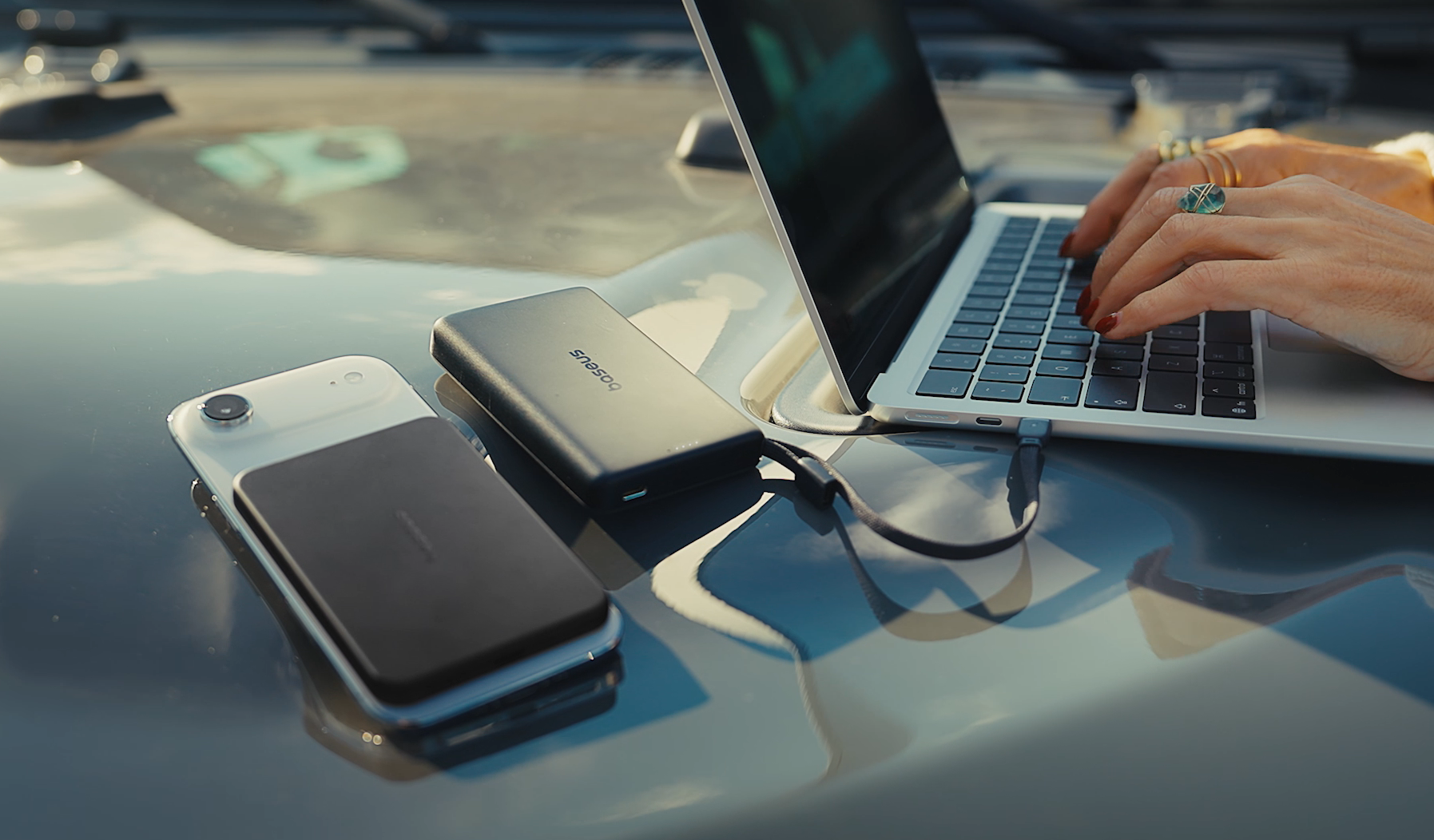
- Supports mainstream protocols to achieve fast-charging: Ensures fast-charging mode is triggered with devices across different brands — with the wired port delivering up to 45W and the wireless port supporting Qi2.2 25W, AM52 can simultaneously charge a smartphone and a laptop without an extra charger.
How to Use Dual-Port Simultaneous Charging Efficiently
Assign Different Devices to Different Ports
Connect high-priority devices via cable and use the magnetic wireless port for low-priority devices. For example, wired port charges primary phone and magnetic wireless port charges devices requiring slow, sustained charging.
Pay attention to the heat dissipation
Avoid the following situations when using both ports simultaneously to prevent thermal throttling and resulting power reduction:
- Using the power bank inside a sealed bag (which hinders heat dissipation)
- Direct exposure to sunlight in summer
- Wireless charging a phone with a thick silicone case
Choose a Capacity That Matches Your Power Needs
The total power output of dual-coil 5000mAh chargers is typically limited to 15W; if you need higher power, you should choose a charger with a capacity of 10,000mAh or more, as this provides a sufficiently high power budget. If iPhone or some Android users want faster charging, they should choose a charger equipped with Qi 2.2, which offers faster wireless charging.
FAQ
Q1: Will charging two devices at the same time with a power bank damage my devices?
No. When each device is connected, the power bank automatically performs a protocol handshake and outputs voltage and current based on what the device can handle, ensuring it does not exceed the device’s tolerance limits. Genuine products all have built-in overvoltage, overcurrent, and overtemperature protection mechanisms, so they are safe for your devices.
Q2: Is it normal for the power bank to get warm when charging two devices at the same time?
When charging two devices simultaneously, the two internal conversion circuits operate at the same time, so it’s normal for the power bank to feel warm. As long as the surface temperature does not exceed 48°C, it remains within a safe range. If it becomes too hot to touch or the power bank automatically reduces its charging speed, this indicates that the thermal protection has been triggered; we recommend moving it to a well-ventilated area for use.
Q3: Why does the charging speed slow down when charging two devices at the same time?
This is because the power bank has a maximum total output power, which both devices must share; consequently, each device receives less power than when charging individually. Additionally, if the device’s temperature rises and triggers thermal throttling protection, the system will proactively reduce the output power further, causing the charging speed to decrease as well. This is a normal design feature and not a malfunction.