 United States/English



 Baseus Store
 Amazon
 Walmart

Most of us don’t think about portable charging until our battery starts flashing red and we are miles away from the nearest wall outlet. Then, we start frantically rummaging through our bag, hoping to find an old charging cable or wishing we had remembered to charge our power bank the night before.
Magnetic power banks will make charging your phone a whole lot easier by snapping onto your device and helping cut down on cable clutter. However, this leads to one common question: "Do MagSafe power banks only work with iPhones?" Let's look at how MagSafe power banks work and which devices can use them.
What’s the Difference Between MagSafe and Wireless Charging?
As magnetic charging has become more popular, many people confuse MagSafe and wireless charging. They work together, but there are some key differences.
Apple introduced MagSafe with the iPhone 12 back in 2020. It uses a ring of magnets embedded in compatible iPhones to help accessories snap into the right place. This allows a MagSafe charger, MagSafe battery pack, wallet, or stand to attach firmly to the back of the phone. However, the technology that charges the device is wireless charging. A phone that does not have MagSafe can still be used with wireless charging. That’s one reason some Android phones still work with a magnetic charger or magnetic power bank.
Today’s wireless and portable chargers often use magnetic alignment to make charging easier and more reliable. The magnets help everything line up automatically instead of having to be careful about where you place your phone on a charging pad. Before we jump into compatibility, it’s important to understand that MagSafe is a magnetic system that makes wireless charging easier.
So, Do MagSafe Power Banks Only Work with iPhones?
Thankfully, no. When people see the word "MagSafe," they immediately think magnetic power banks are only for iPhones. That’s understandable—after all, MagSafe is Apple technology.
However, it's not that simple. One misconception about MagSafe charging is that people think the magnets are what charge the phone. The magnets are there to help keep things aligned. The actual charging process still relies on wireless charging technology, which is why a lot of Android phones can still work with a magnetic power bank.
- For iPhone Users: If you own an iPhone 12 or newer model with MagSafe built-in, you’ll have the most effortless experience. A MagSafe power bank sticks to the back of your device, helping keep it in place as you keep on using your phone. Whether you're discovering a new city, replying to emails on the move, or snapping photos on holiday, you can keep charging without the hassle of cables. Additionally, many users appreciate that a MagSafe battery pack can stay on while you use your phone, as it feels like an extension of the device and not a separate accessory.
- For Android Users: Many Android phones support wireless charging, so you can often charge them with a magnetic power bank. Some users choose a magnetic ring or compatible case for a similar snap-on experience as Apple MagSafe. However, the device model and case design may affect the charging performance and magnetic attachment strength.
- For Devices Without Wireless Charging: If your device does not support wireless charging, the magnetic charging feature will not work. Fortunately, many of the newer power bank models still offer USB-C charging options, letting you charge your device in the traditional manner.
What About Phone Cases?
Cases can make a much bigger difference than most people think. If you use an iPhone, a MagSafe case usually provides the strongest magnetic connection. If you use an Android, a magnetic case or magnetic ring can help create a more secure attachment. So before blaming the charger, it's always worth checking if your case is getting in the way.
Who Should Buy a MagSafe Power Bank?
They are very helpful for:
- Frequent travelers
- Daily commuters
- Students
- Remote workers
- People who constantly forget to charge their phones
After all, MagSafe power banks are all about making charging more efficient, and that’s something iPhone and Android users both can appreciate.
Why Are So Many People Switching to Magnetic Power Banks?
While traditional power banks can get the work done, they aren't the most convenient option. The popularity of magnetic power banks is due to their ability to solve everyday frustrations.
| Benefit | Why It Matters |
|---|---|
| Less Cable Clutter | One of the most annoying things is trying to untangle charging cables when you’re in a rush. Magnetic power banks help you say goodbye to cables, giving you a cleaner charging experience with less setup and fewer accessories. |
| Better Portability | Throughout the day, many people depend on their phones for navigation, payments, work, photography, and communication. A portable charger that attaches to your phone means you can stay charged and still be able to use your device comfortably. |
| More Convenience | A magnetic charger means you can quickly connect and charge as needed rather than having to stop and hook up cables whenever your battery is running low. |
What's the Difference Between Qi2 and MagSafe?
If you have been looking for a wireless charger, you might have heard the term Qi2. At first glance, Qi2 and MagSafe look very similar, and that’s because they are.
Qi2 is the latest universal wireless charging standard, and it offers magnetic alignment technology like MagSafe. A Qi2 charger helps your phone align correctly for more efficient charging, basically like Apple’s MagSafe system. That’s great news, as it means magnetic charging is becoming more widely available across devices and brands. Many of the best wireless chargers and Qi2 power bank options today offer users a more consistent charging experience, with magnetic convenience and improved charging efficiency.
Choosing the Right Magnetic Power Bank
We all have different charging habits. Some of us just need enough battery to get us through a busy weekday, while others may need enough backup power to get through long flights, road trips, commutes, and everything in between. Here are some magnetic power bank options that were built to keep up with different types of lifestyles.
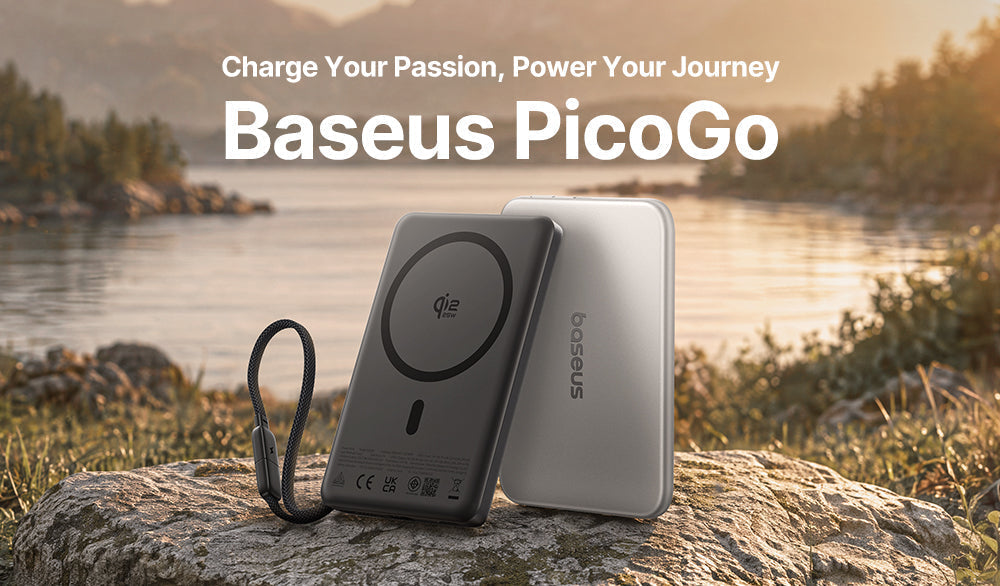
Baseus PicoGo Air

The Baseus PicoGo Air is a good option if you want something small and easy to carry around. At only 0.27 inches thin, it's an ultra-slim magnetic power bank that fits easily into a pocket or backpack without adding a lot of extra weight. It's perfect for those who like the convenience of MagSafe-style magnetic charging but don't want to carry around a large battery pack all day.
Baseus PicoGo AM52

If you are away from power outlets for most of your day, you might be better off with the Baseus PicoGo AM52. It has a larger 10,000mAh battery capacity, so it is great for travel, long workdays, and busy schedules. It officially supports next-gen Qi2.2 ultra-fast wireless charging (up to 25W), while the built-in USB-C cable supports up to 45W fast charging. You can also charge multiple devices simultaneously, making it easy to keep all your essentials powered throughout the day.
The Answer
It's easy to assume MagSafe power banks are just for iPhones; however, magnetic charging is also available to many Android users who own compatible devices and accessories. The most important thing is to find a charging solution that fits your lifestyle. If you prefer portability, then perhaps consider the Baseus PicoGo Air. If you prefer a large amount of backup power, then the Baseus PicoGo AM52 might be a better option for you.
FAQ
Q1: Will a MagSafe power bank work through my phone case?
Yes, but it works best with a MagSafe-compatible case. Thick or non-magnetic cases may weaken the connection.
Q2: Do MagSafe power banks charge devices faster?
Charging speed depends on both the power bank and your phone. MagSafe mainly makes charging more convenient, though newer standards like Qi2.2 can deliver significantly faster wireless speeds on compatible devices.
Q3: Will my phone get damaged by a magnetic power bank?
High-quality magnetic power banks are built for safe daily use and will not damage compatible smartphones when used properly.
Q4: What is the difference between Qi2 and MagSafe?
Both use magnets to improve wireless charging. Apple developed its magnetic charging technology for iPhone, while Qi2 is a universal wireless charging standard that brings similar magnetic convenience and high efficiency to a wider range of compatible brands.