 United States/English



 Baseus Store
 Amazon
 Walmart


Foldable phones have changed the way we think about mobile design. Suddenly, you’re not just dealing with one solid brick, but an interactive and dynamic design. So, when your new phone can now open like a book, the accessories you use with it will have to make a few changes. Today, power banks are a crucial part of everyone’s bustling lives.
Whether you’re at work, travelling, or just taking the bus, a power bank can keep you going for longer. With Apple’s latest release of the iPhone Duo, foldable phones are quickly looking to become a new trend. This is why your power bank needs to adapt as well. Today, we’ll be looking at how power banks for foldable phones should look, what to expect, and how Baseus can be of service. So, why do we need to be thinking out of the box when it comes to foldable devices?
Why the iPhone Duo Needs New Fittings
Apple describes its first foldable iPhone as a device built around a new dual-display form factor, with a 7.6-inch inner display and a 5.4-inch outer display. This creates a unique challenge when it comes to conventional power bank designs. Rather than drawing power from one standard battery, a foldable device typically splits the current between two cells. The iPhone Duo is therefore built with dual, built-in rechargeable lithium‑ion batteries.
The larger camera housing also makes it difficult to fit traditional power banks on the Duo. Power compatibility is also a big element here, as foldable phones consume much more power than regular phones. This means that they need more charging power to effectively keep foldable devices going.
Now, Baseus approaches the solution by looking beyond charging specs to see the complete relationship between a power bank and a foldable device. The idea is simple: a power bank should be designed around the phone, not merely designed to be compatible with it. So, what does the ideal power bank for a foldable phone look like today?
What Makes a Power Bank Fold-Ready?
Generally, power banks are designed as independent accessories. As long as the cable reaches the phone or the magnetic charger attaches securely, the job is considered done. However, foldable phones introduce a lot more variables.
Attaching any accessory depends on the device’s rear panels, camera arrangements, hinges, and proportions. While a regular power bank could technically charge a foldable phone, it would awkwardly block part of the camera and go beyond the phone's edges, making the device uncomfortable to hold.
This is why a power bank for foldable phone use should be assessed on more than battery capacity and charging speed. A fold-ready power bank design should consider:
- 1:1 dimensions
- No unnecessary overhang
- Camera-safe positioning
- Dedicated magnetic alignment
- Thermal management
- Comfortable grip
- Visual integration with the phone
These factors should form part of the foundation of your new foldable phone power bank checklist. Now, let’s look at some of the basic rules of compatibility when it comes to finding a power bank for your foldable device.
The Rules of Fold Compatibility
A power bank should work with an iPhone Duo's physical design, not simply on top of it. These are some of the top compatibility considerations you should think about beforehand:
1. Charging Capabilities
Power delivery is essential for any power bank investment. A beautifully fitted power bank that cannot provide practical charging is basically useless in the real world. For foldable devices, people should look at wireless charging standards, wired output, recharge speeds, and thermal management. Now, the foldable iPhone Duo features a USB-C port and supports both 25W MagSafe and Qi2 charging.
Fortunately, the Baseus PicoGo AM72 Qi2 Magnetic Power Bank is built around this principle, combining Qi2 wireless charging with 25W USB-C wired charging and 18W self-recharging. This provides superior flexibility, allowing users to attach the power bank magnetically when needed or connect by USB-C when wired charging makes more sense.
2. Magnetic Attraction
Magnetic charging only works well when alignment is reliable. For a magnetic power bank for foldable phone use, the magnetic system needs to account for the specific phone rather than relying on a generic placement.
The AM72 uses 12N magnetic force, N54H rare-earth magnets, and a silicon steel sheet, with a dedicated magnetic layout developed around the iPhone Duo. This ensures stronger magnetic alignment, providing precise positioning to keep your charging components correctly aligned while also allowing the power bank to only occupy the intended area of the phone's rear panel.
3. Size and Dimensions
Compatibility is not only about whether two pieces of technology communicate correctly. It can also be about how naturally they work together physically. This is where fold-ready design becomes particularly challenging for most power banks. A conventional power bank might be slightly wider or longer than the phone and still work perfectly well. However, on a foldable phone, that extra size can interfere with the device's carefully considered proportions.

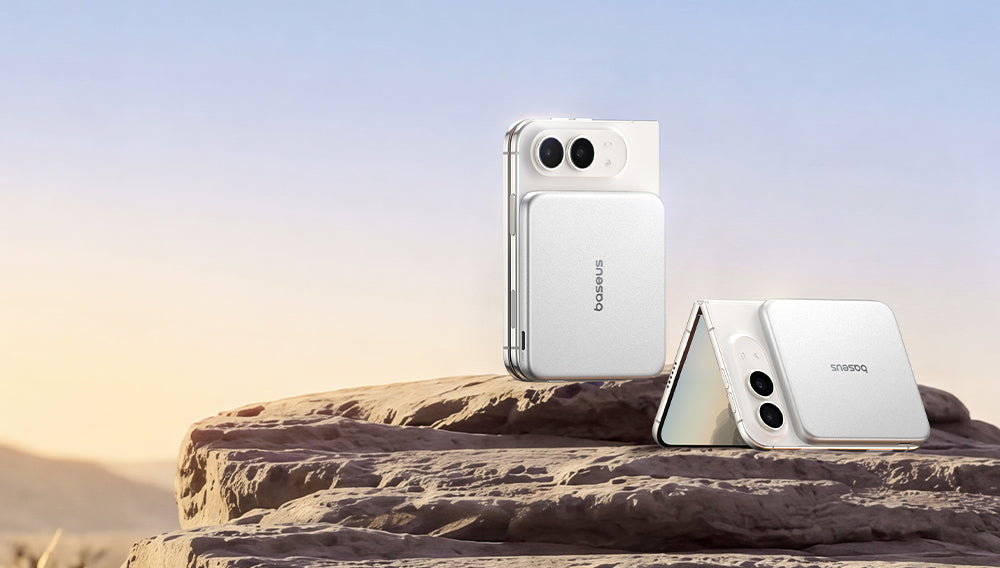
The AM72’s 7.9 mm ultra-thin body is designed to be a 1:1 match for the iPhone Duo, staying within the phone's contours rather than extending beyond them. This creates a precisely tailored fit that considers dimensions, camera placement, and magnetic positioning. The result is a seamless accessory profile without unnecessary overhang that fits the shape of your camera.
The power bank’s thin, fitted 12N magnetic design also fits flush against the device, making it ideal for one-handed use on the go when your phone is folded. When unfolded, it charges effortlessly despite the larger screen's high power consumption.
4. Design Details
Foldable phones represent a significant shift in smartphone aesthetics. Their appeal comes partly from the way engineering, materials, and proportions come together. That means an accessory attached to the back of your phone shouldn’t undermine that design.
The AM72 power bank uses rounded edges and an R-corner design that echoes the phone's form. Its finish is intended to complement the minimalist aesthetic of the phone rather than appear like an unrelated accessory. Instead of treating the power bank as an external object, the design approach makes it part of the overall device experience.
5. Comfort and Ergonomics
Finally, another practical consideration is how the phone feels when the power bank is attached. A power bank that technically fits but creates an awkward edge, protruding corner, or uncomfortable grip can make everyday use a hassle.
However, the AM72's rounded edges and precise dimensions are built to maintain comfortable contact with the phone body. Its slim profile also helps reduce the feeling of carrying a second, separate device on the back. For a foldable phone that may be opened, closed, held horizontally, held vertically, or used while charging, this physical integration matters more than you know.
Thermal Fit Matters, Too
Now, foldable phones are sophisticated devices with multiple displays and demanding internal components. This means that their charging process also generates more heat, particularly during wireless charging.

This makes thermal design another part of fold compatibility. The PicoGo Air AM72 Qi2 Magnetic Power Bank incorporates a Glacier Cooling Structure 2.0 alongside an AI adaptive temperature management feature called ActiveGuard 2.0 (thermal control algorithm) to make charging a cooler, more comfortable experience.
For Baseus, the goal isn’t simply to make charging possible, but to manage the physical conditions around charging more thoughtfully. The same principle applies to battery intelligence. Through PowerSense NFC, the AM72 can go a step further and connect with the Baseus app to provide information about battery health and key-cell status, keeping you in-the-know and updated at all times. Now, let’s add all these features up to see what the perfect power bank for foldable devices should look like.
Your Ultimate Foldable Power Bank Checklist
Putting everything together, a power bank designed for a foldable phone should meet a broader set of criteria based on the following key factors:
- Charging: Does it provide practical wireless and wired charging capabilities?
- Magnetic attraction: Are the magnets strong enough and positioned specifically for the phone?
- Size: Does the power bank follow the phone's dimensions without unnecessary overhang?
- Camera safety: Does its placement avoid interfering with the camera system?
- Thermal management: Is heat actively considered during wireless charging?
- Appearance: Does the material and finish complement the phone?
- Grip: Does the accessory remain comfortable when attached?
A New Standard for the Foldable Accessory Era
As foldable phones become more popular and advanced, accessories will need to become more specific. The traditional approach asks, "Can this power bank charge my phone?" But now, the fold-ready approach asks a much broader question: "Does this power bank belong with my phone?"
The Baseus PicoGo AM72 represents this second approach. Its 1:1 dimensions, camera-safe fit, and 7.9 mm aluminum-alloy body pair perfectly with its Qi2 wireless charging, 25W USB-C output, and cooling system, ensuring the integrated aesthetics are more than just a pretty face built around your new phone.
The future of mobile accessories shouldn’t just be about making one accessory compatible with as many devices as possible. Instead, it should be about creating accessories that understand the device they are made for. A truly fold-ready power bank doesn't just charge a foldable phone. It fits it, aligns with it, complements it, and feels like part of it.
FAQ
Can you use a power bank with a foldable phone?
Yes. Traditional power banks may not fit as precisely as a dedicated power bank, like the PicoGo AM72. A power bank for foldable phones needs to consider charging capacity, size, magnetic alignment, camera clearance, and cooling.
What type of power bank should I use for an iPhone Duo?
A power bank with precise dimensions, a camera-safe magnetic layout, suitable Qi2 charging, reliable magnetic attachment, cooling, and a profile that follows the phone's contours.
Why does 1:1 sizing matter for a foldable phone power bank?
It prevents unnecessary overhang and keeps the accessory aligned with the phone's physical design, preventing the camera from being covered and making the device easier to hold.
Is magnetic attraction important for a power bank for foldable phone use?
Yes. Strong and precisely positioned magnets keep the power bank aligned with the phone and maintain the intended wireless charging position.
Does a foldable phone power bank need thermal management?
It’s an important element, as wireless charging generates a lot of heat. Temperature monitoring and dedicated cooling can help manage charging conditions safely and comfortably.