 United States/English



 Baseus Store
 Amazon
 Walmart

As you’re getting ready to leave your home, dreading the long day ahead of you, you grab your phone and notice that the battery is at 15%. That is exactly when a magnetic power bank will save the day. But not all magnetic power banks offer the same experience. You’ll find one that has a sleek, clean design and is wireless, while another one has a built-in cable that provides you with flexibility. So, which one should you choose?
Let's compare the features, advantages, and lifestyles that they each pair well with so that you can make an easy decision when scoping for your next magnetic power bank.
Wireless-Only Magnetic Power Banks
These power banks are all about convenience. They simply attach to your compatible phone magnetically and begin charging without using a cable. If you use an iPhone that comes with Apple MagSafe or a compatible MagSafe case, the charger will automatically align so that there is a secure and stable connection. But, if you have one of the newer Android models, then do not worry. You can enjoy a similar experience if you pair your Android device with compatible magnetic accessories.
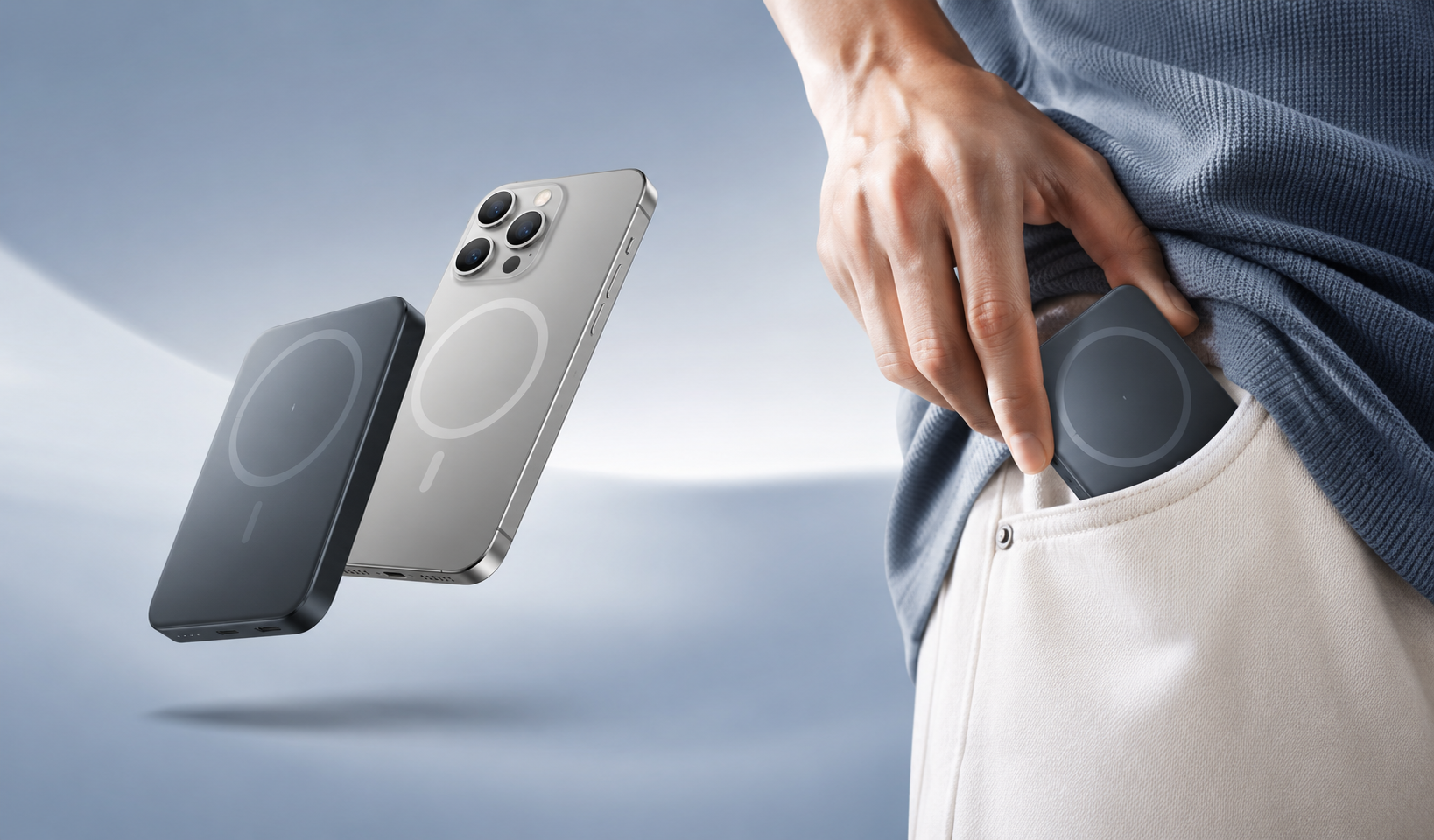
Since these power banks do not have a built-in cable, they are usually thin and lightweight, and they’ll fit comfortably into your pocket or bag.
An example of a wireless magnetic power bank is the Baseus PicoGo Air. It has a slim design which makes it ideal if you’re looking for something that is easy to carry around and does not add extra bulk to your pockets or bags.
 Magnetic Power Banks with Built-In Cables
We all want the best of both worlds, and these types of magnetic power banks are exactly that. There is the convenience of wireless charging, but if you need some extra speed, the integrated cable is ready for use.
You are not limited to charging only one device, as there is the added option of charging tablets, wireless earbuds, or even another smartphone with the built-in cable. That is what makes these types of power banks both convenient and versatile.
The Baseus PicoGo AM52 is for those who prefer versatility and flexibility. You’ll never have to remember to pack a cable, as it already comes with one that is built-in.

A Quick Comparison
| Feature | Wireless-Only Magnetic Power Bank | Magnetic Power Bank with Built-In Cable |
|---|---|---|
| Portability | Ultra-slim | Slightly thicker |
| Charging Speed | Fast wireless | Faster wired + wireless |
| Charging Methods | Wireless charging only | Wireless and wired charging |
| Multiple Device Charging | One device | Up to 3 simultaneous devices (depending on available outputs) |
| Cable Required | No | Built-in USB-C cable that is included |
| Best For | Everyday carry | Travel & multitasking |
| Main Advantage | Slim & lightweight | Flexible & powerful |
Which One Charges Faster?
While wireless charging has come a long way, magnetic power banks with built-in cables still have the upper hand when it comes to charging speed. A wired connection transfers power straight from the power bank to the device, which allows more energy to reach the battery with less power lost along the way.
The reason wireless charging is different is that it uses magnetic induction to transfer the energy between the charging coils inside the power bank and your phone, rather than sending the electricity through a cable. Even though this creates a wireless charging experience, some energy is lost during the transfer, and that makes wireless charging a little less efficient than wired charging.
However, not all wireless chargers will perform the same way. Modern magnetic power banks with Qi2.2 support have made wireless charging much faster. Qi2.2 uses the Magnetic Power Profile to make sure your charging coils are aligned perfectly when you attach the charger to the device. When the alignment is perfect, there is less wasted energy, less heat, and just better charging all around.
The good news is that the Baseus PicoGo Air 10,000mAh and PicoGo AM52 support Qi2.2 wireless charging with up to 25W output. The PicoGo Air 5,000mAh supports Qi2.0 wireless charging, providing reliable magnetic charging in a more compact design. For even more power, the PicoGo AM52 also supports 45W USB-C wired fast charging, giving you the flexibility to switch between wireless and wired charging whenever it's convenient.
Does Thinner Mean Less Powerful?
While the notion that a thinner power bank means less power and performance may have been true in the past, the progress that has been made in battery technology and engineering has made it possible to create thinner designs that don’t compromise the charging abilities. Today’s high-end power banks have high-density battery cells and thin wireless charging coils so that the thickness of the power bank is reduced and battery performance is not compromised. The internal layouts of the power bank are also carefully engineered so that the power bank stays as thin as possible. All of this allows manufacturers to create compact power banks that are easy to hold and carry with you while also being powerful enough to deliver fast and efficient charging.
The size of the power bank is usually just a design choice and not an actual indicator of the quality. The ultra-thin models usually favor portability, and the thicker models use the additional internal space to include more hardware, like large battery cells, built-in cables, more charging ports, and higher charging outputs.
Why is Cooling Technology Important
Fast charging is naturally going to generate heat, especially when it’s wireless and some energy is lost as heat during the transfer between charging coils. If there is no proper cooling system, those higher temperatures can decrease the charging performance, and the device will experience slow charging speeds so that the battery is protected.
That's why you'll find that premium magnetic power banks use technologies like graphene heat-dissipation layers, aluminum alloy housings, AI temperature monitoring, and an advanced airflow surface design that improves airflow to help dissipate heat. Together, these features spread heat more evenly to maintain stable charging performance and support better long-term battery health.
Choosing the Right Power Bank
Let's compare the features of the Baseus PicoGo Air and PicoGo AM52 so that you can make the right choice when it comes to a power bank that suits your lifestyle.
Baseus PicoGo Air vs. Baseus PicoGo AM52
| Feature | Baseus PicoGo Air | Baseus PicoGo AM52 |
|---|---|---|
| Best for | Portability | Fast charging and versatility |
| Battery capacity | 5,000mAh or 10,000mAh | 10,000mAh |
| Wireless charging | Up to 25W Qi2.2 (10K model) | Up to 25W Qi2.2 |
| Wired charging | Up to 30W USB-C (10K) | Up to 45W USB-C |
| Built-in cable | No | Yes (selected version) |
| Simultaneous charging | Wired + wireless | Up to three devices (selected version) |
| Main advantage | Ultra-thin and lightweight design | Built-in cable and faster wired charging speeds |
It All Comes Down to Your Needs
Both wireless-only and wireless magnetic power banks that include built-in cables have their advantages, so the correct choice depends on how well it will fit into your daily routine and lifestyle.
If you want something that is easy to carry, thin, and fits comfortably in your hands, then consider the Baseus PicoGo Air. For someone who likes to have multiple charging options in one device, our recommendation is the Baseus PicoGo AM52. Either way, your new magnetic power bank will be the ideal companion when you have long days and far commutes.
FAQ
Q1: How long do magnetic power banks last? When should you replace it?
A high-quality magnetic power bank can go through hundreds of charging cycles before its battery capacity decreases. Details like how often it is used and how it is stored will determine the life capacity of the power bank.
Q2: Can I charge my devices overnight with a magnetic power bank?
Yes. Many high-quality power banks are equipped with intelligent battery management systems that monitor the temperature, voltage, and current so that the device charges safely.
Q3: How do I know if my phone supports Qi2?
Simply check the specifications of your phone or the manufacturer’s website. Most newer smartphones support Qi2, and the older ones may support standard Qi wireless charging instead.
Q4: Why are some magnetic power banks more expensive than others?
The higher-end models often include newer charging standards like Qi2.2, faster wired charging, stronger magnets, improved cooling systems, and other safety mechanisms. All of these improve the charging performance and durability.