 United States/English



 Baseus Store
 Amazon
 Walmart

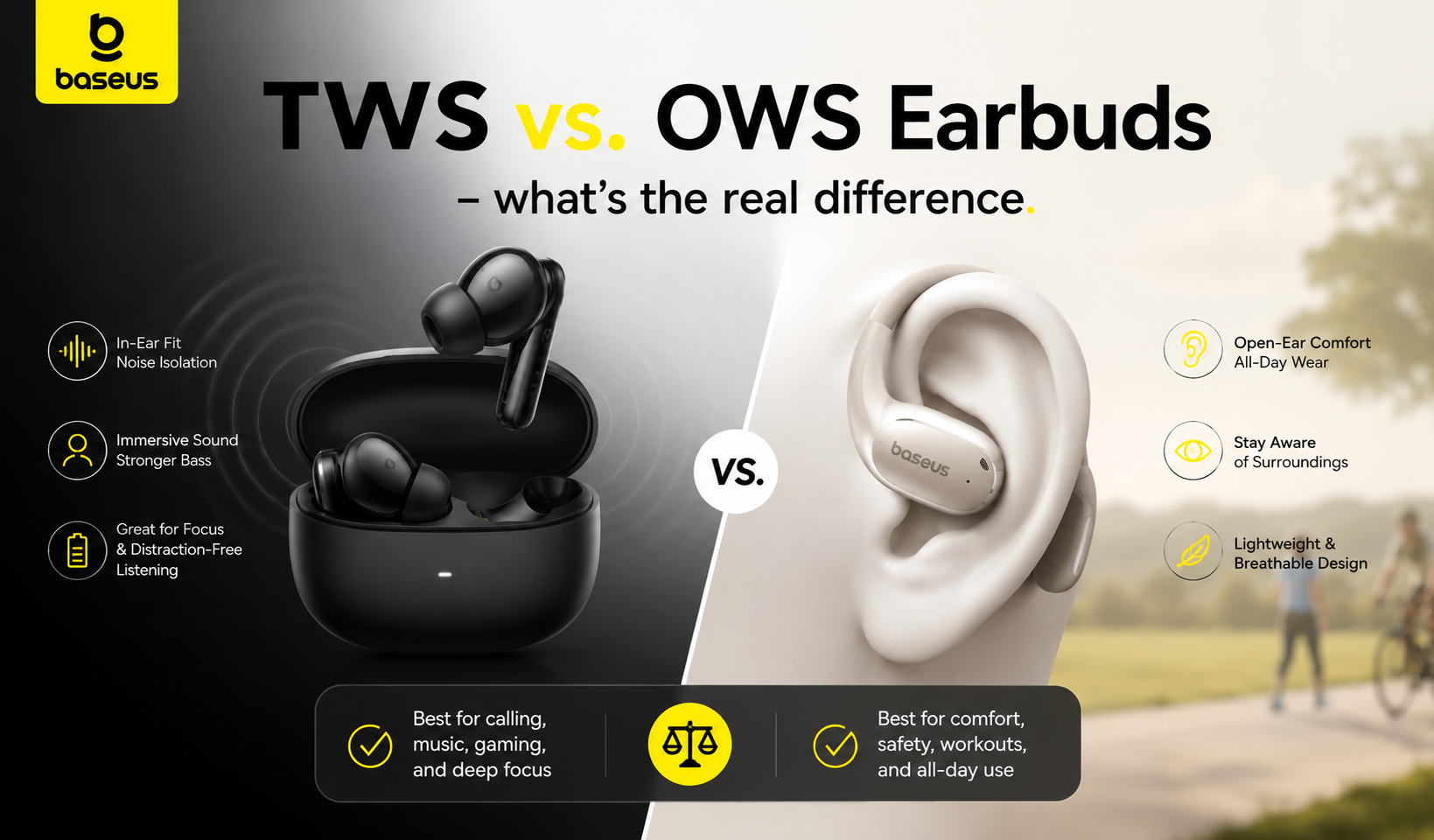
We all need a pair of earbuds, but not all ears want to be sealed. Some people need to hear their surroundings for safety. Some have very sensitive or sweaty ears. Open-ear earbuds solve that problem. They are as small as regular earbuds, but they do not go into your ear canals. You (kind of) get the best of both worlds: small and comfortable. With brands continuing to innovate in this form factor, they also sound pretty good. Now is a great time to get into the world of OWS earbuds. This guide helps you better understand the different kinds of OWS and identify the best pair for you.
What are OWS Earbuds?

OWS stands for Open Wearable Stereo. Simply speaking, these are open-ear wireless earbuds that do not go deep into your ear canal. They sit around the ear, on the ear, or just outside the ear. They are also different from bigger headphones, as they are very small and compact. In theory they won't sound as good as in-ear design because open design reduce sound intensity and introduce background noise. But nowadays, OWS is catching up fast. If you are not a auidophile it will definitely make you smile.
There many ways open-ear attach to your ear and that will be how we group different kinds of OWS. Short answer: choose the "clip" style for most use cases. Baseus Inspire XC1 is its best sounding clip while the Baseus Bowie MC2 is the comfort leader in this category.

| Type | Design | Pros | Cons |
|---|---|---|---|
| Ear-clip / clip-on | Small clip hangs on the edge of your ear; speaker sits near, but not inside, the ear canal; very light (a few grams/side). | Very comfortable with minimal ear pressure; sound is closer to ear canal so mids and bass feel fuller; looks new and cool, a conversation starter. | In extreme movement (dancing, HIIT) you may feel some earbud movement; in very noisy places you may need higher volume because there is no sealing. |
| Ear-hook | Hook goes behind your ear; speaker unit floats beside the ear opening like mini sports headphones. | Very stable for running, cycling, gym; usually larger batteries for better all-day life; no clipping on ear edge, so even less physical pressure. | Bulkier and more “sporty” looking, less minimal; because nothing clips or inserts, they can fall off in extreme scenarios if the hook fit isn’t perfect. |
| Headband | Flexible band on head; open speaker units by ears; similar to bone-conduction shapes, used for open air conduction too. | Strong grip for excellent stability; often large batteries for long playback, good for long-distance running or travel. | Least “true wireless” feeling and more visible on head/neck; not pocketable. |
How to Choose an OWS Earbuds?
Now the practical part. When you are deciding which product to get, you first need to know what the main features are and what they mean to you. For OWS, comfort is the first thing to consider; if comfort did not matter much, you would have chosen in-ear buds. Second is sound quality, which is where, in theory, open designs are weaker, and also where the best ones shine. Finally, there is call quality, as making calls is another major use case for OWS.
Comfort and fit
This is number one. If the fit is not right, no spec can save it.

- Check weight per earbud: lighter usually means more comfortable for long wear. Try to find those single-digit-gram ones.
- Look at contact points: does it press on the top of your ear, behind your ear, or just clip softly on the side? Does it have a large contact area? Every ear is different, so a large contact area and good materials are important.
- Check structure: look for durable and flexible hooks or clips that keep the earbuds safe in place, but still comfortable. The balance of stability and comfort is very tricky. But great products strike a good balance.
Baseus is a pioneer in OWS comfort technology. Try the Baseus Bowie MC2 to find out. It is an open‑ear clip‑on earbud with a CloudComfort 2.0 wrap-around cushioning design. The air-cushion ear tip are made from ultra-soft silicone, certified by TÜV Rheinland and SGS, and adapt comfortably to different ear shapes with several sizes to choose from.
Sound quality and especially bass
Open design means you will never get the same sub-bass rumble as fully sealed in-ear earbuds. But you still want clear vocals and a bit of punch.

- Focus on mid and high clarity for podcasts, calls, and vocals. Look for clarity and response.
- Look for bass-enhancing design, like drivers angled toward the ear canal, or software EQ to boost low frequencies without distorting.
Baseus also produces some of the best-sounding OWS out there. With Baseus Inspire XC1, which is developed with Sound by Bose, as one of the best OWS in the market now. Baseus Inspire XC1 features a Hybrid 2-Way Driver System with Knowles balanced armature drivers, Dolby Spatial Audio/Hi‑Res/LDAC support/SuperBass 3.0, and comfortable all‑day wear focused on delivering rich, detailed sound for an open form factor.
Calls, noise, and microphones

Many people use open-ear as their all-day con-call device in addition to music listening device. Look for environmental noise cancelling or ENC. That's not cutting the noise you are listening to, but the noise that people on the other end of the phone can hear. In general, more microphones mean better call quality: six mics perform better than four, and four better than two. With additional microphones, the device can more accurately pick up both your voice and ambient sounds, then enhance speech while reducing noise. You not only need to worry about your own listening but also the experience of the ones you talk to.
Conclusion
OWS offer better comfort, better awareness, making earbuds not just a listening device but also a companion. They won’t replace every in-ear or over-ear headphone on the market right now, but they are getting better and better and now is the percfect itm to get a pair yourself.
FAQ
Q1: Are OWS earbuds safe for running and outdoor workouts?
Yes, OWS earbuds are widely viewed as one of the best and safest options for running. Because they sit outside the ear canal, you can still hear traffic, pedestrians, and your surroundings while listening to music or podcasts. This makes open-ear wireless earbuds a popular choice among runners.
Q2: What is the difference between OWS earbuds and bone conduction headphones?
Both are open-ear audio solutions, but they work differently. Bone conduction headphones press against your cheekbone and transmit vibrations through your bone. OWS still deliver sound through the air with a driver positioned just outside the ear canal. So OWS would sound the most "normal".
Q3: Who should buy open-ear earbuds? Are they good for office use and all-day wear?
Open-ear earbuds are ideal for anyone who finds in-ear earphones uncomfortable after long periods, or who needs to stay aware of their surroundings. Office workers who are constantly on and off con-calls. Runners who need to be aware of their surroundings are all top users for OWS.