 United States/English



 Baseus Store
 Amazon
 Walmart

Magnetic power banks can be a great gadget. Instead of connecting it to your phone with a cable, it simply snaps on. No wonder it has become more and more mainstream nowadays. However, it can also be daunting to choose the right one. There is no single standard that covers it all, there are the industry standard, itterations, and sub standard and they are all on the market right now! If you get the wrong one, you either waste your money or miss the features you could have experienced. This guide is here to help you. After reading it, you will understand all the different standards and be able to choose the best ones for you.
What is Qi and how does it affect compatibility?
Qi is the universal standard of wireless charging, defined by the Wireless Power Consortium (WPC). Most wireless charging devices today follow this standard. But Qi is not just one standard; it has different versions. There is Qi, the earliest base version. The faster and newer Qi2 and the latest and fastest Qi2 25W (or unofficially Qi2.2). Like most namig scheme in tech, just remember, the bigger the number in the name, the more powerful it gets.
| Standard | Max power output | Key feature highlight |
|---|---|---|
| Qi | Up to 5W | Basic wireless charging; some phones exceed 5W via proprietary schemes |
| Qi2 | Up to 15W | The faster ones and widely adopted ones on the market |
| Qi2 25W (Qi2.2) | Up to 25W | Newer Qi2.2 profile offering faster 25W magnetic charging |
*Actual charging power varies by device and charger compatibility.
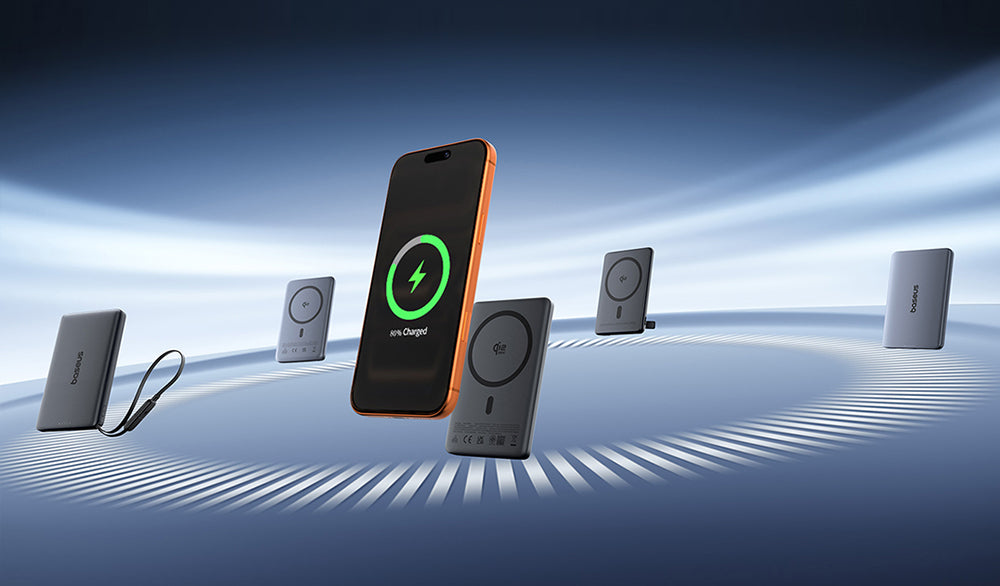
Newer Qi power banks can charge older devices, just at lower speeds. For example, the Baseus PicoGo AM52 that supports Qi2 25W can charge newer iPhones or compatible Android phones at higher speeds, but it will still work fine with older phones that only support basic Qi at a lower speed.
What is Qi2 25W (Qi2.2) and when should you choose it?

Qi2 25W (often referred to as Qi2.2) is the latest evolution of Qi2. The charging speed, as the name suggest, goes to 25W top. That's a significant jump from Qi2. The problem is that right now only a few flagship smartphones supports it. You are talking about the iPhone from 16 gen and up, and selected models from Samsung and Google's latest flagship lineup.
Then should you go for it if you are using an older smartphone? First Qi2 25w power banks work with Qi2-equiped smartphones at a lower speed. And power banks like Baseus PicoGo AM52 with Qi2 25W are durable quality products that are going to last you for years. If you want to future-proof. It's not a bad idea to switch early.
What is Qi2 and when should you go for it?
Qi2 is the "mature" upgrade over classic Qi. It brings magnetic alignment and supports up to 15W wireless charging. In real use, Qi2 is already enough for most people. It gives you:
- stable magnetic attachment
- predictable charging speeds
- wider range of products to choose from
If you want something reliable today and want to look into wider variety of products. Qi2 power banks are a safe middle ground.
When should you just go for basic Qi?
Basic Qi is the simplest and cheapest option. But it is also the slowest.
- Charging speed: around 5W
- Magnetic alignment may not be guaranteed
It still works fine for older phones and other gadgets like earphones and toothbrushes. It is not the fastest, but it is mature and works with everyone. If it is not your main charging option for your power-hungry devices, it will be fine.
What are the best Qi2 charging products on the market?
Qi2 25W standard is still pretty new. Only a handful of brands have real products in the market. Baseus is one of the first to support it. And models like the PicoGo AM52 and related ecosystem products are among the first Qi2 25W products on the market.

Baseus PicoGo AM52
The Baseus PicoGo AM52 supports Qi2.2 25W and has 10,000mAh of power. It is just 16mm thick and weights less than 200g. You are not only getting fast wireless charging. You also get up to 45W wired USB-C output. That's enougn to charge a lot of pads and compact laptops. It is absolutely a compact charging beast!
For Qi2 power banks

If you are not chasing 25W wireless yet, the Baseus PicoGo AM41 (Qi2) is also great: 10,000mAh, 15W magnetic wireless, up to 27W wired. It offers stable charging, compatibility across wider range of phones, and at a lower price point. For many users, Qi2 still hits a good balance between performance, price, and ecosystem support.
Conclusion
In the end, buying a magnetic power bank is less about chasing the latest buzzword and more about finding the most suitable for and worthy for you. And to do that, you need to understand the tech that you are getting and make sure it works with what you already have.
FAQ
Q1: Will a magnetic power bank damage my phone battery?
Not really, as long as you are not buying some no-name, poorly made product. Proper Qi power banks and phones already manage heat and power pretty tightly.
Q2: Why does wireless charging feel slower and hotter than wired?
Because it kind of is. Wireless charging always loses some energy in the form of heat, that’s just how the tech works. What you lose in speed, you get in convenience. Plus, with Qi2 25W, you are not losing that much of speed.
Q3: Do magnetic power banks work with Android phones?
Yes, but it depends on the phone. Newer Android models that support Qi2 will work much better, with proper magnetic alignment and decent speeds. Older ones can still charge with Qi, but you might need a magnetic case or ring to make it snap on.