 United States/English



 Baseus Store
 Amazon
 Walmart

As power banks continue to evolve, they've taken on a massive variety of designs. Now, picking the right one out of this diverse range is actually pretty important. Different designs are simply better suited to specific devices and usage scenarios. That being said, a power bank with only a single design might not fully cover all your charging needs for various devices and situations.
Among the most common types on the market, the primary distinction comes down to magnetic power banks and those without magnetic functionality. So, when comparing magnetic power banks vs. non-magnetic power banks: Which One Is Right for You? This blog will provide a quick overview of both types. We'll highlight the key differences between their designs. Finally, we'll conclude with some guidance on selecting the exact right power bank for your needs. Let’s dive right in.
How does magnetic power banks work?
As is well known, magnetic power banks attach to your phone via magnetic force to charge it. However, it is not the magnet itself that performs the charging function. It is the wireless charging coil that delivers power to the phone, combined with the Qi standard to maximize compatibility and the wireless charging experience. Next, we’ll explain the operating principles of magnetic power banks in detail:
1. Aligning the device using magnetic force
The magnets inside a magnetic power bank do not perform any magical “charging functions.” Their primary role is to securely attach the power bank to the back of the phone and help align the internal coil with the charging area. The magnetic force range for magnetic power banks is generally between 3N and 13N. This range of magnetic force essentially covers the charging needs of existing devices of varying weights and different usage scenarios. Power banks with lower magnetic force are suitable for lightweight phones without cases or those already equipped with magnetic cases, while those with higher magnetic force are suitable for more turbulent or extreme environments.
2. The component that actually delivers power—the wireless charging coil
Now, once aligned with your device via magnetic force, the wireless module kicks in to transfer power. The internal coil generates a high-frequency alternating magnetic field at the contact surface. The receiving coil in the device (like an iPhone) then captures this field. From there, it converts it into electrical energy that flows straight into the battery. Of course, wireless power transfer inevitably results in some energy loss—which mostly turns into heat. Because of this, high-quality power banks usually incorporate cooling tech to minimize it.
3. The Qi 2 standard ensures a stable magnetic charging process
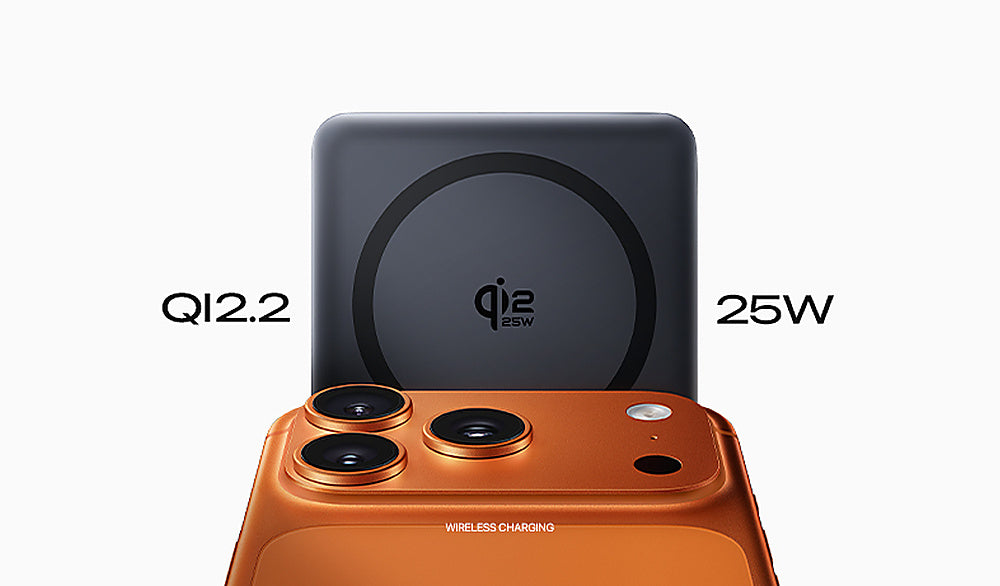
An increasing number of new-generation magnetic power banks are adopting the Qi 2 standard—the latest magnetic wireless charging standard. Its focus is on improving the alignment accuracy between devices and chargers, enhancing device compatibility, and delivering a more stable wireless charging experience.
Magnetic vs. Non-magnetic Power Bank: Key differences
Let’s take a closer look at the specific forms of magnetic and non-magnetic power banks commonly seen today. The following summarizes the core differences from several perspectives, including magnetic characteristics, features, functional characteristics, usage scenarios, and design:
| Availability | Sub-Category | Core Feature | Typical Capacity Range | Typical Output Range | Best-Fit Devices | Best-Fit Use Scenario | Appearance |
|---|---|---|---|---|---|---|---|
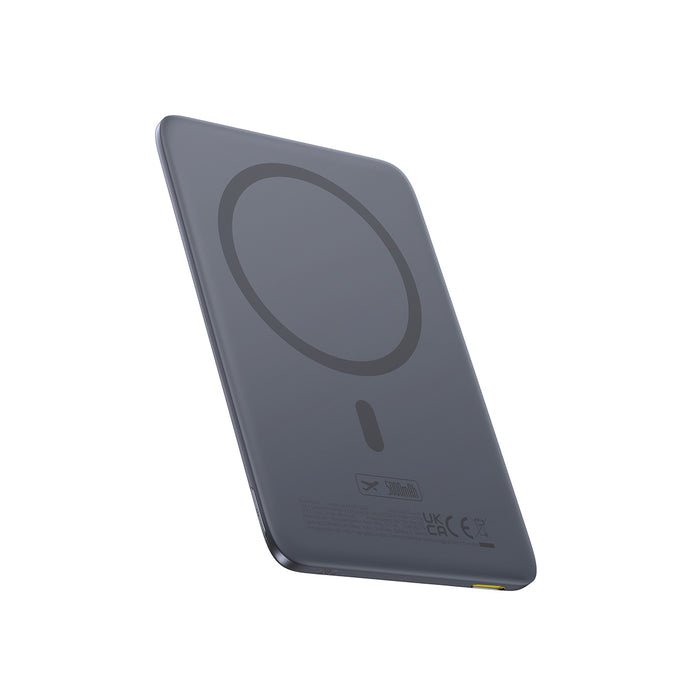
| Magnetic | Wireless magnetic power bank | - Usually slim design for easy carry - Only relies on magnetic snap-on charging |
5,000mAh - 10,000mAh | Wireless: 15W-25W Wired: 20-22.5W |
- Phones - Earbuds - Some wearables |
- Daily commuting - Pocket carrying - Quick top-ups |
 |
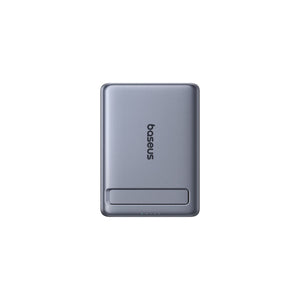
| Magnetic | Magnetic power bank with kickstand | - Usually slim design for easy carry - With a foldable stand - Can stand upright on flat surfaces - Allows vertical or horizontal phone placement |
5,000mAh - 10,000mAh | Wireless: 15W-25W Wired: 20-45W |
- Phones - Earbuds - Some wearables |
- Daily commuting - Pocket carrying - Quick top-ups - Charging while video watching |
 |
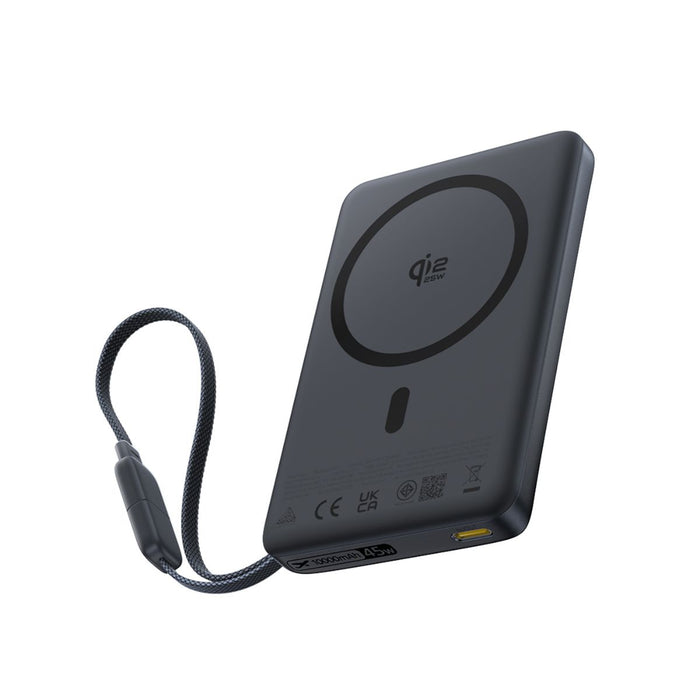
| Magnetic | Magnetic power bank with Built-in-cable | - Dual charging modes (wireless + wired) - Free from extra cords |
10,000mAh | Wireless: 15W-25W Wired: 20-45W |
- Phones - Earbuds - Some wearables - Laptops |
- Multi-device charging at the same time - Carrying laptops on trip - Cord-free travel |
 |
| Non-magnetic | Non-Magnetic power bank with built-in-cable | - Only relies on cable charging - Along with built-in-cable |
10,000mAh - 20,000mAh | Wired up to 45W - 100W | - Phones - Earbuds - Some wearables - Devices without magnetic availability |
- Multi-device charging - High-power demand |
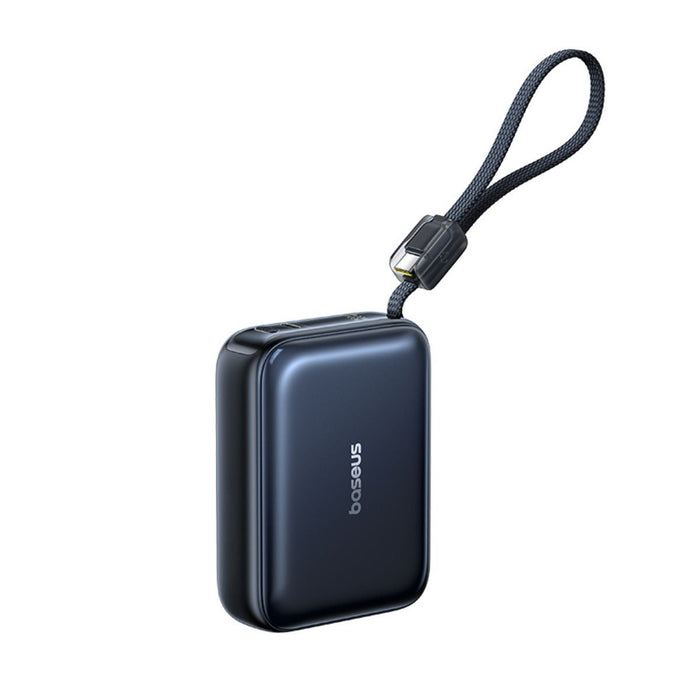 |
Magnetic vs. Non-magnetic Power Bank: Which one is right for you?
The information above should help you understand the specific differences between various power banks. Next, let’s explore further: In which situations is which one best suited you? This question is actually closely tied to the devices you use, your usage scenarios, and your lifestyle.
Highly recommend magnetic power banks if you need...
-
Priority for phone charging: In everyday life, you often carry only your phone and can’t take your eyes off it. For example, you might need to reply to messages constantly while on the go or engage in other activities that require keeping your phone screen on for extended periods. So you need an ultra-slim power bank to quickly juice up your phone anytime. The Baseus PicoGo AM41 perfectly fits the bill—at just 0.36 inches thick and weighing 3.8 ounces, it’s remarkably slimmer and lighter than your iPhone. A simple snap on connection effectively relieves your phone battery anxiety.

- Free from bulky chargers and tangled cords: Many people have experienced the frustration of not having enough space in their backpacks when traveling. Heavy charging devices and tangled cables in your backpack can be a real drag. When your backpack space is extremely limited and packed with other essential items, a magnetic power bank is the best space-saving choice. Plus, a magnetic power bank with its own built-in cable helps reduce the need to carry a bunch of extra cables.
-
To get the most out of your MagSafe ecosystem: It’s important to note that not all magnetic power banks support MagSafe. If your device happens to support MagSafe or the latest Qi 2.0 protocol, this is a great opportunity to reap the benefits of a magnetic power bank. A reliable magnetic power bank truly makes for a perfect match, and the Baseus PicoGo AM52 with its built-in cable delivers exactly that. With the AM52, you unlock the maximum 25W Qi 2.2 wireless output, alongside a 45W built-in cable. This allows you to confidently charge three devices at the same time. More importantly, it minimizes power transfer losses and the unpleasant experience caused by high temperatures through strict temperature control technology.

Highly recommend non-magnetic power banks if you need...
- Preference for charging via cable: If you find that charging via a data cable aligns with your usual habits, of course, you can stick with it. Wired charging is compatible with a wider range of devices and offers higher output power. However, if you don’t like carrying a cable, a compact, built-in-cable power bank like the Baseus PicoGo AC22 is likely exactly what you’re looking for. It packs 45W and 20,000mAh into a surprisingly compact design. With dual-device support and a clear digital display, it provides a visual power backup.
-
An elegant design for non-magnetic devices: It’s clear that many products today still lack support for magnetic charging. This isn’t necessarily a drawback, though, as there are still plenty of high-performance non-magnetic power banks that deliver an excellent charging experience. Take the Baseus EnerFill FC41 Digital Display Power Bank as an ideal example. Armed with a massive 20,000mAh capacity and 100W PD output, it delivers ultra-fast charging for both phones and laptops.

Conclusion
Magnetic vs. Non-Magnetic Power Banks: Which One Is Right for You? This blog post explores the underlying principles, specifications, key differences, and typical designs of both types of power banks, along with considerations and recommendations for choosing the right one for your needs. In reality, there is no absolute “better” or “worse” between the two types of power banks. But no matter which one you choose, Baseus power banks are committed to meeting your core needs. By maintaining cutting-edge charging technology and minimalist aesthetic design, Baseus charging products are sure to make the list of your top charging choices. Don’t hesitate—give them a try!
FAQs
Q1: Can I use a magnetic power bank if I don't have an iPhone?
It’s not limited to iPhones. It depends on whether your phone has built-in Qi wireless charging capabilities. The underlying technology of magnetic power banks typically uses the universal Qi or Qi 2 wireless charging protocols, so they are technically compatible with Android phones that support wireless charging.
Q2: Are magnetic power banks slower than regular wired ones?
Wired charging is generally faster than wireless charging. Standard non-magnetic wired power banks can easily hit 22.5W, 45W, or even 100W. Meanwhile, under the latest Qi 2.2 protocol, wireless charging maxes out at 25W. That said, you can't definitively say which method is better—it really just depends on how you balance your priorities.
Q3: Do I need to remove my phone case to use a magnetic portable charger?
Well, this mostly depends on the type and thickness of your phone case. If you’re using a case with a built-in MagSafe module, you can simply slap it on to charge. For silicone or other composite cases that are 2mm thick or less, the magnetic hold is usually weakened. So, these setups are better suited for stationary or stable charging situations. But if things get fast or bumpy? The power bank can easily slip right off due to the looser connection.